Grief Doesn't Need Letting Go
Oct 31, 2026
Grief Doesn't Need Letting Go
Why we may bring the people we have lost back into our lives
There are people we lost many years ago whose absence still touches us as deeply as if they had died only yesterday. Sometimes all it takes is a familiar smell, a particular place, an old photo or a dream in which we meet them again, and suddenly the pain is back, the pain we thought we had worked through long ago. We wake up and for a brief moment everything is the way it used to be, until we realise that this person is no longer here and that we can never return to them in the same way again.
It is exactly then that a thought often arises which deepens the suffering even more: Why am I still so sad? Why haven't I finally worked through this after all these years?
We live in a society that has surprisingly little room for grief. When someone dies, we are allowed to be sad, to cry and to withdraw, but at some point we are expected to function again, to look ahead and carry on with our lives. And when the grief is still there years later, we begin to doubt ourselves and wonder whether something is wrong with us.
Yet grief has no fixed timetable. How deeply a loss touches us does not depend only on how long someone has been gone, but also on what this person meant to us and the place they held within us.
Sometimes, with the death of a family member, we lose not only a beloved person but also a place of safety, a sense of home, or the experience of being unconditionally accepted and loved.
When Death Overshadows a Whole Life
In our therapeutic work we see again and again that people suffer not only from the loss itself, but also from the way it happened. A serious illness, a harrowing farewell or the experience of not being there in the final moments can imprint themselves so deeply that at some point they overshadow every other memory.
Then we think of someone we loved and no longer see the many years we shared, the beautiful encounters, the laughter or the closeness, but mostly the last stretch of their life.
In our memory, the person we loved becomes more and more tied to their dying.
This becomes especially painful when the farewell was accompanied by helplessness, horror or guilt. Our mind keeps returning to the decisions we would make differently today, to the words we never got to say, and to the moments when we would have loved to be there for this person one more time.
But a person is so much more than the way they died.
They lived, loved, laughed, talked and touched us in their very own way. We shared countless moments with them that belong to our story just as much as their death does.
That is why an important part of grief work can be not to look only at the loss, but to invite the whole of the life we shared back into our memory.
The familiar gestures, the shared meals, the conversations, the little quirks and all the unremarkable moments that seemed so ordinary back then that we had no idea how precious they would one day become.
This is not about pushing away the terrible experiences or covering them up with beautiful memories. The horror and the helplessness belong to it too. But they do not have to remain the only images we connect with someone we loved.
Why We Don't Have to Let Go of Our Grief
One of the most common pieces of advice grieving people hear is that they finally need to let go.
But what exactly are we supposed to let go of?
The love for a person who accompanied us for many years? The memory of a place where we felt safe? The longing for an embrace that used to comfort us?
We do not have to give up this connection in order to go on living.
Grief is not simply an unpleasant feeling that should disappear as quickly as possible. It is also an expression of our love and of the meaning a person had for us. And sometimes, precisely because of this, we need not less remembering, but more.
We may take out old photo albums, let shared experiences come alive again, tell stories and consciously take in what this person gave us. We may speak to them, tell them that we miss them, and remember what it felt like to be loved by them.
Such memories can be painful at first, because they connect us directly with the loss. That is why they need gentleness and the freedom to pause at any time. But alongside the pain, the warmth of an encounter, the joy about what we lived together and a gratitude can become tangible again, a gratitude that is not set against the grief but is allowed to exist alongside it.
Working through grief does not mean that one day we no longer feel anything when we think of someone who has died. It means that our relationship with this person may once again become bigger than the pain of losing them.
When Guilt Gets Stuck in Grief
Not all grief consists only of missing and pain. Often it is also bound up with guilt, anger, helplessness and regret that we carry within us for many years.
We reproach ourselves for not having had enough time, for having made the wrong decision, or for having left someone we loved alone at a crucial moment. Even when we know rationally that we could not have acted differently back then, a deep sense of guilt sometimes remains.
And this is exactly where it becomes clear why we cannot process feelings through thinking alone.
The mind can explain to us a hundred times that it was not our fault, that we did our best, or that the past cannot be changed. But the feeling in our body does not automatically follow this logic.
First of all, it wants to be felt and expressed.
Sometimes it helps to sit in front of a photo and say out loud what we still want to tell this person. That we are sorry we were not there. That we regret a decision, or that we still wish everything had turned out differently.
We do not have to prove that our guilt is justified. This is not about judging ourselves, but about giving space to the feelings we have carried within us for so long.
A letter, a conversation with someone we trust, or a conscious ritual of remembrance can also help to express something that has not yet found a place.
Grief Needs People Who Can Stay
Something that touches us deeply in our work is the loneliness many people experience in their grief.
Not necessarily because no one is there, but because hardly anyone is truly willing to stay with them in this pain.
We have learned to respond to difficult feelings with advice. We try to explain why someone should see it differently, point out the positive sides, or look for a way to ease the pain as quickly as possible.
Yet grieving people often need something completely different.
They need someone who listens without analysing their grief. Someone who holds them without expecting everything to be fine afterwards. Someone who can hear the story for the tenth time, because they understand that it is not about new information, but about the fact that this pain is still there.
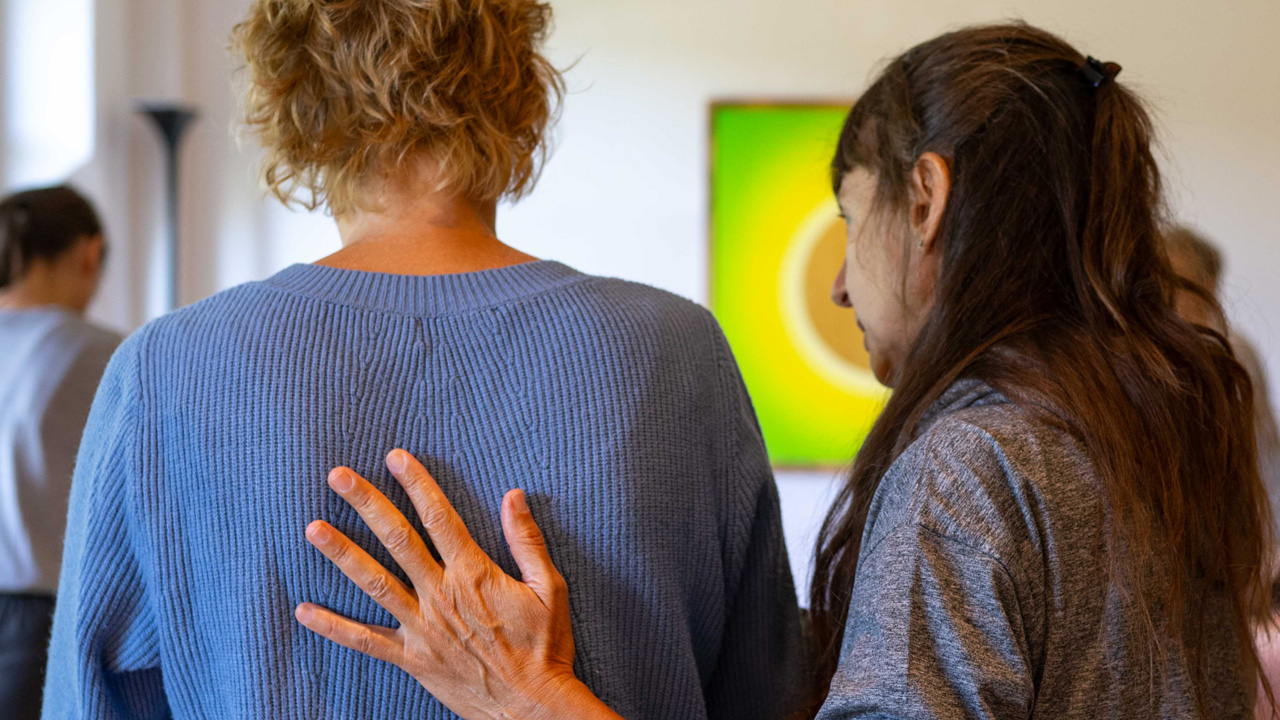
Sometimes the deepest form of accompaniment is surprisingly simple: we are there and we let the other person feel.
We do not have to understand, judge or change the grief. We do not have to know how much longer it will last, nor do we need to find a solution for it.
It is precisely this ability to stay with a person without immediately wanting to do something with their feeling that is one of the most important qualities of emotional accompaniment. Because when a feeling is truly seen and shared by another person, something arises that we can often hardly experience on our own: we are no longer completely isolated with our pain.
When Love Finds Its Place Again
In our memory, a loved one consists not only of their death, but of a whole life, of countless encounters and of everything that came alive in us through them.
When we begin to allow this whole story back in, our relationship with the loss can change. The grief does not have to disappear for this, and we do not have to come to terms with everything that happened at some point either.
We may go on missing, crying and being sad, while at the same time love and joy about what we lived together find their place again.
In this way, even a home that no longer exists can remain part of our life, because the experiences of safety, closeness and love did not disappear with its walls.
We cannot bring back what is no longer physically here. But we can find our way back to what this person touched and left behind in us, without letting the pain of their death become the only truth about our shared story.
Grief does not always need letting go. Sometimes it needs more remembering, more feeling, and people who are willing to walk this path with us.
For death ends a shared life, but it does not take from us the love that grew within it.
Space for Your Grief
Some losses stay with us for many years, and sometimes we notice that we can no longer move forward on our own with our grief, our memories or the feelings we have never expressed. In our personal sessions we also accompany you in working through your grief and give space to what has not yet found a place. This is not about letting go of someone you love or getting over the pain as quickly as possible, but about allowing and expressing your feelings at your own pace and finding your way back to the love and connection that have remained alive behind the loss.
If you would like compassionate support along the way, we are here for you.
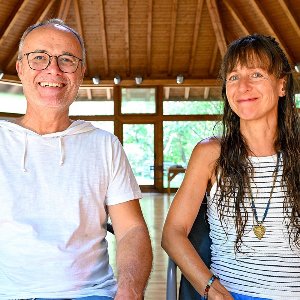
Pratibha & Kareem