Transforming Feelings? No Thanks!
Oct 05, 2026
_Your feeling is not the problem_
The attempt to heal, transform or let go of our feelings can be exactly the thing that keeps pulling us further away from ourselves.
The therapeutic and spiritual world offers countless methods that promise to change unpleasant feelings. Anger is supposed to become strength, fear is supposed to become trust, pain is supposed to become love and insecurity is supposed to become clarity. Behind this lies an idea that seems perfectly logical at first: if something feels unpleasant, something has to be done about it.
But why, really?
Why can't a hurt simply be a hurt? Why does fear have to be calmed down right away? Why do we need a solution for insecurity as quickly as possible? A feeling is not wrong just because it is unpleasant. It can be just as intelligent and important as one that feels good.
We don't need more methods to change our feelings. We need to learn to feel them again.
Because, surprisingly, the transformation of our feelings usually begins long before we apply any therapeutic method. Someone says something to us and for a brief moment we feel hurt. But this moment is so subtle and so uncomfortable that we hardly notice it.
Seconds later we are angry. We think about what the other person did wrong, defend ourselves inwardly and may still be telling the story of how impossible this person is hours later.
And we believe we are feeling.
Of course we are feeling something. But often we are no longer feeling what was originally there.
Beneath the anger there may be a hurt, beneath the irritation an insecurity, beneath the defence a sense of shame, and beneath the despair a brief moment in which we did not feel seen, loved or safe. These original feelings are often so subtle and inconspicuous that our entire body-mind system has learned to skip over them in a flash.
Then we spend hours with the anger and wonder why it won't go away.
It cannot truly dissolve as long as the actual feeling underneath it is not given any space.
You can talk for a very long time about how angry you are, you can express your anger, _scream it out, analyse it_ or try to turn it into something constructive. If there is a hurt underneath, none of these movements will feel that hurt for you.
For that, you have to go back.
Back to that small moment you would rather have skipped.
This is exactly where feeling becomes uncomfortable, because here we can no longer so easily hold the other person responsible. For a moment there is no big story. There is only the simple truth: That hurt me. I felt insecure. I felt ashamed. I was afraid.
For the mind, this is often far more uncomfortable than anger. Anger gives us a position. Anger can give us the feeling of being strong and of knowing who is right and who is wrong.
Vulnerability, on the other hand, takes this certainty away from us for a moment.
And yet this is exactly where its power lies.
When we can stay with what really happened, we no longer have to run away from ourselves. We begin to experience that a hurt does not destroy us, that insecurity can be endured and that shame does not mean there is something wrong with us. We don't have to transform the feeling, because we discover that we are able to feel it.
This fundamentally changes our relationship with ourselves.
We stop accepting ourselves only when we feel good. We stop constantly correcting our inner world. Instead, we begin to give our attention to what is happening within us. In this lies a much deeper form of self-love than in the constant attempt to bring ourselves into a better state.
Interestingly, this is often exactly where the very change we were so desperately trying to create arises. A feeling that is truly allowed to be felt doesn't need to be held on to endlessly. Something can relax, move and eventually release, because we have stopped fighting against it or trying to turn it into something else.
So we don't have too many feelings.
We have too little contact with our real feelings.
We live in a world in which we have learned to take our thoughts incredibly seriously while overriding our most subtle sensations. Yet it is precisely these sensations that offer us important orientation. They show us with which people we open up, when something becomes too much, when we need space, which relationships nourish us and which decisions feel deeply right within us.
When we lose this access, we don't only lose our vulnerability. We lose a part of our inner navigation.
Then we make decisions out of fear, habit or old ideas about what our life should look like, and at some point we wonder why, despite all the work we have done on ourselves, we don't feel truly connected.
Emotional growth is therefore not about producing ever better feelings. It means being able to feel more and more truthfully what is actually there.
And this is exactly where one of the deepest transformations lies: we stop wanting to constantly transform ourselves.
We learn to stay with ourselves and to feel what is really there. In doing so, beneath all our strategies, protective mechanisms and stories, we rediscover something we almost overlooked in our attempt to keep improving ourselves: ourselves.
The feeling was never the problem.
The fight against the feeling is what pulled us away from ourselves.
_The art of staying with the person_
This very kind of feeling is an essential part of our Emotional Therapeutic Coach training.
Emotional guidance does not mean changing, dissolving or turning an unpleasant feeling into something positive as quickly as possible. Far more important is the ability to recognise what actually wants to be seen and felt beneath all the reactions, stories and protective mechanisms.
That is why, in the training, we explore not only trauma, emotional processes and the nervous system, but above all the intelligence of feeling itself. We learn to perceive the subtle original feelings, to better understand emotional reactions and to create a space in which people can come closer to themselves again and experience the deep wisdom of their feelings.
This also changes the role of the one who accompanies. The more we ourselves have learned to stay present with vulnerability, insecurity, fear, shame or pain, the less we need to transform another person's feelings. We can be there, listen, perceive and hold a space in which the other person can rediscover their own ability to feel.
Therein lies a deep form of therapeutic work: supporting people to reconnect with what is true and alive within them, and what offers valuable impulses for aligned steps and encounters.
If this kind of guidance touches you – for your own path or for your work with other people – then our Emotional Therapeutic Coach training is an invitation to get to know feeling even more deeply and to discover the potential it holds for healing, relationships, awareness and a more authentic life.
Link: www.cominghome.ch/emotionaltherapeutic
Love
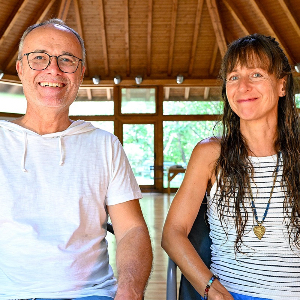
Pratibha & Kareem